Now Hans van Zijst is retiring, he looks back together with Marc Wesselink one more time back: on their joint career, the development of SOM, and of course on fourteen years of WesselinkVanZijst. ‘Even if half the project team is panicking, I remain calm in my chair.’
Marc: ‘Hans, time for a little trip down memory lane. Do you remember where and when we first met?’
Hans‘Certainly! That was in 1992 in Maastricht, during an international conference on the development of national environmental policy. It was organized by the International Network of Green Planners (INGP), a network organization for environmental policy planning of which we were both members.".
I was working on environmental policy as a diplomat for the Ministry of Housing, Spatial Planning and the Environment (VROM), and you delved into it as a consultant at the advisory firm ERM. We clicked immediately. But actually, what I remember most is an illustrious moment in a hot tub in Costa Rica, a few years later.’
Marc: ‘That sounds very vague and wrong, if you don't know the story...’
Hans: ‘A little context: we were responsible for the process of an INGP meeting in Costa Rica. One afternoon, a visit to the rainforest was planned for the participants. We wanted to go there with the whole group, but hey, we still had to prepare our evening program. The two of us stayed at the hotel to do that preparation.
At one point, we were done, and it was extremely hot. So, we just sat in that water. When the group came back sweaty from the humid jungle, the two of us were still sitting in that hot tub. A memorable moment! In that hot tub, you first asked me if I wanted to come work at ERM. That’s where it all started for us, in retrospect.’
Marc: ‘I want to discuss our collaboration in more detail later, but first, a transition to the content: when did you have the ‘click’ with the mutual gains mindset?’
Hans‘That was also in the early 90s: the Mutual gains approach (MGA) came over from America and took off in the Netherlands. My colleagues and I at the ministry had been working on a new, national environmental policy plan for some time. We moved away from simply imposing strict rules and limits on companies. Instead, the realization dawned that we needed industry for our economy and employment, but that the environment also needed to become cleaner.
All of this happened thanks to the ministry of Pieter Winsemius in the years prior. It called for a new approach: collaboration between businesses, government, and other stakeholders to find the best solutions together.
The new way of thinking fit perfectly with the mutual gains approach, where all parties benefit from cooperation. More and more people grasped this idea. So did I. Mutual gains, in short, was the ideal foundation for further promoting environmental policy. I quickly saw its potential, believed that this approach offers added value – and still do. In 1986, I was involved in one of the first covenants, concerning the reduction of mercury content in small batteries. This was followed by many agreements with industry. After two decades of prescriptive legislation, that became the dominant approach.’
Marc: ‘You usually point to others who took the lead in this, such as MIT professor Larry Susskind and the responsible senior official of the ministry. But didn't you also play an important role in the development and dissemination of mutual gains yourself?’
HansI was in Washington from 1991 through 1994. The ministry put me forward to give lectures on Dutch environmental policy. It was truly the era of ‘The Netherlands, the land of missions,‘ you know. Meanwhile, that missionary feeling has completely faded, but back then we thought it was very important to tell other countries how we approached cooperation in our country.
Moreover, the Dutch industry was like: it's fine if we lead the way with environmental policy, but we'd like the rest of the world to catch up a bitequal playing field). So I traveled everywhere to tell how we, government and business together, did this.’
Marc: ‘Something completely different that most people don't know: your role at the Second International Water Conference, in March 2000 in The Hague. Tell us about it?’
HansIt was 1998 by then, and a reorganization was approaching at VROM. You were still trying to convince me to come work at ERM, where you were now the director. I was interested in that, in principle, but I kept putting it off. Until the Ministry of Foreign Affairs asked if I wanted to organize the international water conference in 2000.
’We're going to tackle this on a grand scale,’ they said. That sounded good to me, and it was easiest to do as an external consultant. So in November '98, I joined ERM to organize the Water Conference from their office. From that moment on, I was busy with that World Water Conference three to four days a week for two and a half years. It turned out to be even bigger than I thought.’
Marc: ‘During that conference, Prince Willem-Alexander played Also a role, right?
Hans: ‘Yes, the Crown Prince was the chairman of the conference. It was an important moment in Dutch constitutional history, as this was the first time Willem-Alexander stepped out as an ambassador for Dutch water management. He took it very seriously. He had an adjutant from the ministry who supported him, and he was briefed by the crème de la crème of the water world.‘
Marc: ‘A crazy project. Right after that, you really became a consultant at ERM, didn't you?’
Hans: ‘Correct, but not long after that, you switched to TwynstraGudde! That was quite a bummer. But anyway, at ERM, I took responsibility for government projects. As an external consultant, I was given all sorts of facilitating chair roles in large participatory processes. Then I would spend seven evenings discussing new nature policy, and subsequently fourteen evenings on new air quality policy.
’Participation was a bit of a stretch, actually; what happened there was just a presentation for 90%. During those evenings, people from the ministry would come to talk about the plans. At the end, there was time for a few questions. We’d handle that completely differently now.”
Marc: ‘In that respect, Project Maasvlakte 2 was a turning point for me. Both in terms of content, because we really started working with Strategic Environmental Management, and for our collaboration. How do you see that?’
Hans: ‘That’s right! I started my own business in 2005 and that finally gave us the freedom to work together without being tied down by complicated non-compete agreements. You called right away, I still hear you say: ‘It’s time we’ve really done something together.’’
Marc: ‘I was already working on the Second Maasvlakte at that time, and you joined our team as a freelancer. Not much later, we got a call asking if we could do the same for the new
A4 Delft-Schiedam. Then the ball started rolling.
Hey, I've sometimes wondered: why does it work so well between us? I'm more of a seeker, a connector: I see space and opportunities everywhere. To be able to do that successfully, you need someone who also sees that and is good at finishing things. Those puzzle pieces fit together really nicely. What do you think?’
Hans: ‘I can't say it any better than that! I felt a certain chemistry between us from the very beginning. During my time at the ministry, you regularly came to our office for consultations. You'd always pop your head in the door. And I regularly caught myself thinking: it's so incredibly nice to work with that man.
So when you let me know in the fall of 2010 that you wanted to leave TwynstraGudde, and immediately followed up by asking if we shouldn't start a company together, I didn't hesitate for a moment. You said, ’I really only want to do strategic environmental management anymore, no more of all those chairman roles. Just let's get to work, the two of us." Well, that's how WesselinkVanZijst was born.’
Marc: ‘But we weren't a duo for long. Mart joined the company after just over a year and a half. Then Janneke, Jeroen, Eric... and the rest is History.
If I look at the map of the Netherlands, you can now draw a number of serious circles around spatial projects that carry your signature. The
Second Maasvlakte, of A4 Delft-Schiedam, of Blankenburg Connection, of
ZuidasIs it coincidence that you've always taken on such large projects?’
Hans: ‘No, that's no coincidence. Because once you get into it, you become known in the field. Look at the people who worked on the Betuwe Route, or on other major spatial projects: you keep encountering the same professionals. Because there are only a few who can do this, who have the knowledge and experience to guide such major societal tasks. And the best professionals always have a full schedule.’
Marc: ‘Looking back, what is your ‘signature’ on such assignments? What characterizes your work?’
HansBringing calm. That's what everyone gets back from me. With major challenges, with gigantic stakes, a lot often goes wrong. Then there's another crisis meeting, and they call me. First, I calmly look: what's really going on here? Can we get the parties around the table together? Half the project team is sometimes in panic mode, but I always stay put in my chair.
Rest is very important, because emotions often lead to wrong reactions. Therefore: first count to ten, breathe, then count again and thoroughly analyze the situation. What happened? Have the interests changed? Have any interests been overlooked? And then engage in conversation, verify with the other person if your analysis is correct: not judgmentally, but openly and – still – genuinely interested. Stay true to our starting points of MGA and SOM.’
Marc: ‘Last question: our joint little project, WesselinkVanZijst – how do you personally look back on it?’
Hans: ‘That's not a ‘small project,’ of course. You know, in my working life, I've never worked in the same team for so long. From VROM, I worked in waste management for six years, in information policy for three years, in America for three years, and in international environmental affairs for five years. Then five years at ERM, five years for myself... and then suddenly fourteen years at WesselinkVanZijst. That says something!
And this didn't happen because I got older and didn't feel like changing anymore. It was a great party to develop our firm. With wonderful, loyal clients and with a growing group of enthusiastic colleagues. It was also a commitment that we both made to each other that autumn of 2010. At that moment I knew: this is an adventure. We will succeed, and I'll do this until I retire.’
Marc: ‘And that's how it went. Thank you, Hans, and see you soon!’
In late 2024, Hans van Zijst and Jeroen Medema released the
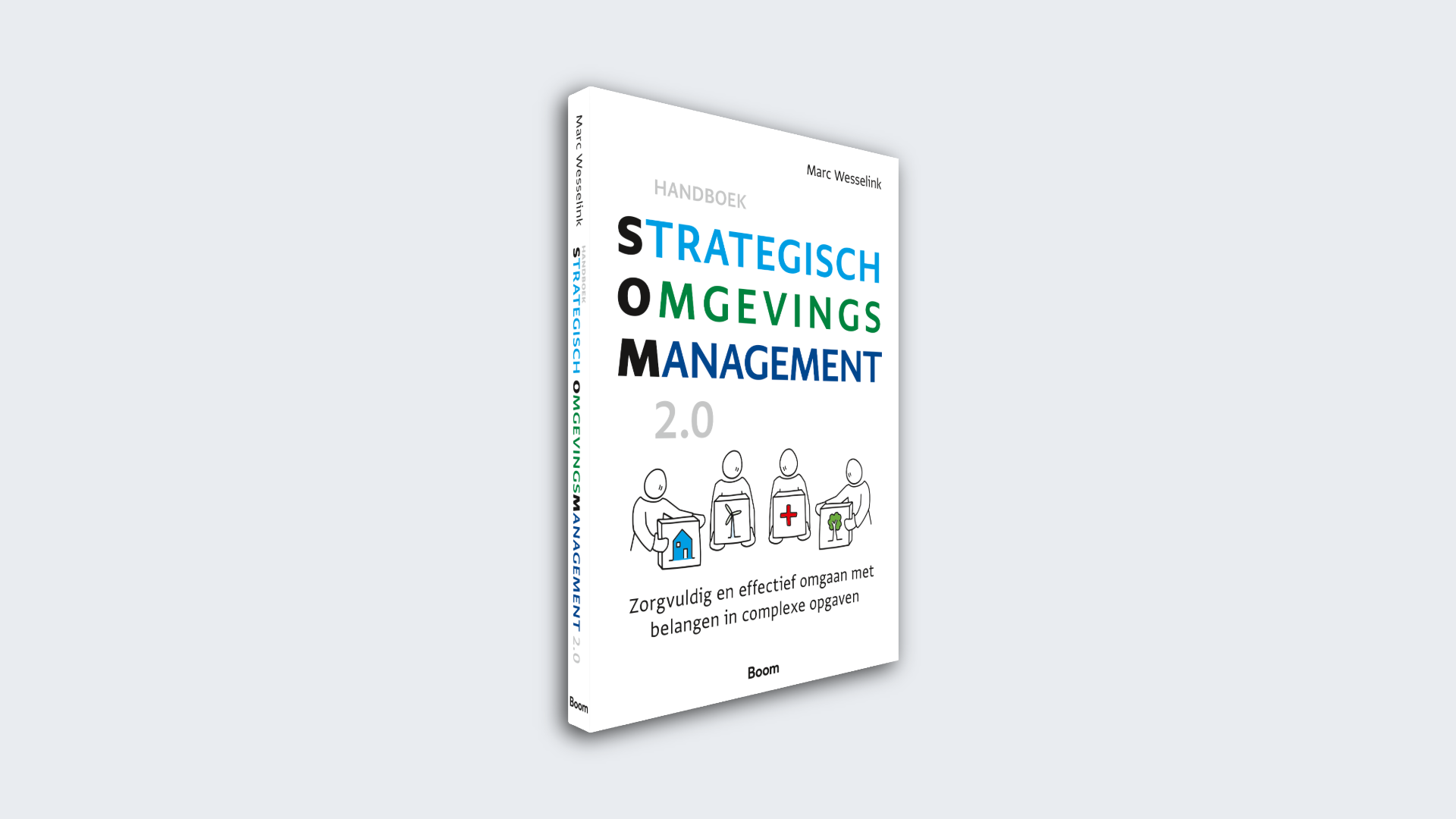
Strategic Environmental Management Practical Guide from: a sequel to the
Handbook Strategic Environmental Management by Marc Wesselink. We’ll soon be sharing a series of videos on LinkedIn, in which Hans and Jeroen will discuss the contents of the practical guide in more detail. Stay tuned for our LinkedIn page Watch out!